
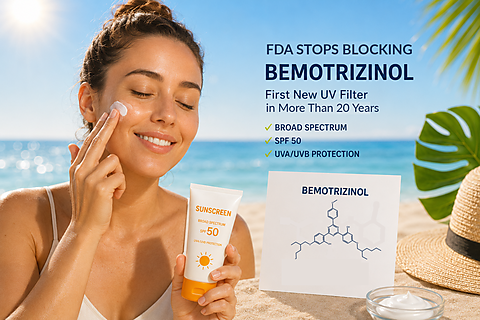
When US residents barbecue and bask in the sun this July 4 to celebrate the 250th anniversary of “a new nation, conceived in liberty,” we still won’t be free to exercise one right that Europeans and others have been free to exercise for decades.
The US Food and Drug Administration (FDA) announced that it will no longer block manufacturers from selling the sunscreen ingredient bemotrizinol in the United States—yet the ban will remain in place until August 9. Why should you care that the FDA was banning sunscreens with bemotrizinol? Those products do a better job of blocking cancer-causing UVA rays than the sunscreens currently available to US consumers. They are more comfortable to use and thus offer still-greater protection because people will be more likely to use them. “This is overwhelmingly a positive development,” said Yale University professor of dermatology Mona Gohara. Sounds great, right?
Except, bemotrizinol has been available in Europe since 2000. The FDA has been blocking US consumers from using it all this time. While European authorities have been busy removing regulatory barriers to 30 different active sunscreen ingredients, the FDA had removed barriers to only 17—and none since 1999. Manufacturers have been petitioning the FDA to remove obstacles to bemotrizinol for over 20 years.
The FDA can’t claim that it has been keeping consumers safe. David Andrews, deputy director of the nonprofit Environmental Working Group, has remarked that relative to sunscreens currently available in the United States, “a number of these newer chemicals have a better safety profile in addition to better UVA protection.” If anything, the FDA has been undermining its own mission and making US residents less safe.
Cato Institute scholars have repeatedly criticized the FDA for denying US consumers their right to buy these products. George Mason University economist Alex Tabarrok has been banging on about FDA delay in approving new sunscreens since 2013. This insane situation has generated perplexed stories in major news outlets. And Rep. Alexandria Ocasio-Cortez (D‑NY; “AOC”) has complained that this a clear case of government overregulation.
Why did the FDA spend 20 years blocking this safe, effective sunscreen ingredient—and why does it still block so many others like it?
One reason is that the FDA is just responding to the incentives it faces. As I write in my latest book Recovery,
Type I errors [read: blocking a harmful product] bring swift and certain retribution down on agency officials. The victims are easily identifiable.…Type II errors [read: blocking a beneficial product] bring almost no consequences for FDA officials. Even though delaying or blocking beneficial drugs can harm patients as much as approving unsafe drugs can.… Victims of Type II errors are much harder to identify. It appears the disease, not the FDA, killed them.
Due to this fundamental information asymmetry, the political system can discipline FDA officials only when their decisions cause patients to suffer or die from Type I errors. It effectively cannot discipline FDA officials when their decisions cause patients to suffer and die from Type II errors.
The FDA rationally focuses its energies on avoiding the harms that new products (might) pose and almost completely ignores the harms that the agency itself creates by blocking beneficial products. The result is that the FDA hurts more than it helps. I discuss one study of new drugs that found “the FDA was inflicting 12 times as much harm on patients through Type II errors as it was sparing patients by avoiding Type I errors.” My counterintuitive conclusion:
If FDA officials want to promote health, they should regulate less. They should approve new drugs faster and with less evidence of safety and effectiveness.
An interesting question is why, when it comes to sunscreens, the FDA appears to lean into these incentives more than European and other regulatory bodies that face the same incentives. A leading hypothesis is one that AOC mentions: Congress requires regulators to hold sunscreen ingredients to a higher regulatory standard (drugs) than European authorities do (cosmetics).
A second part of the answer is the way we talk about the FDA. Our everyday language hides what the FDA does and spares the agency the voter fury it has earned.
Start with a simple idea: You have a fundamental right to make your own health decisions. (Skeptics, see the Declaration of Independence’s second “among” and the Constitution’s Ninth Amendment.) When the FDA blocks you from buying sunscreens or other health products from willing sellers, it violates that right—along with others, including free speech.
When the FDA removes those barriers, we call it an “approval.” But look at what actually happened: Government simply stopped blocking a product—stopped threatening to punish companies that sell it. We describe this as the FDA doing something helpful, when really it’s announcing that it will stop doing something harmful. When we say the FDA is “giving” consumers access to beneficial products, we credit government for removing harms the government itself inflicted.
We also turn the Declaration on its head. We talk as if the freedom to make our own health decisions is something the government hands out—something regulators “allow.” All humans are created equal, but regulators who get to make other people’s health decisions for them are more equal than others.
Proceeding from a presumption of power (i.e., government should make these decisions) is no less an ideological choice than proceeding from a presumption of liberty (i.e., individuals should make these decisions). Only one of these presumptions appears in the Declaration and Constitution, though. These rhetorical conventions may simplify the prose, but they perpetuate the insanity.
————
So what should Congress do about it? In an ideal world, Congress would eliminate the FDA and other government interventions that prevent the health sector from solving the public goods problem the FDA does so much harm trying to address.
Until that becomes politically feasible, Congress should remove barriers to US consumers purchasing health products available in other countries. Tabarrok writes, “Politicians as far apart as Sen. Ted Cruz, R‑Texas, and Rep. Alexandria Ocasio-Cortez, D‑NY, have indicated support for fast-tracking approval in the US for at least some drugs and devices already approved in other developed countries—a rare moment of wise bipartisan agreement.”
The danger is that the FDA will take the same sluggish approach to removing barriers to sunscreens that it has to removing prescription requirements. Medical authorities have begged the FDA to eliminate prescription requirements from, for example, all contraceptives and all forms of the opioid-overdose-reversal drug naloxone. Instead, the FDA has removed prescription requirements from just one oral contraceptive (the “mini pill,” in 2023) and two naloxone nasal inhalers (Narcan in 2023 and Rextovy earlier this month). Since President Trump pledged back in January that his “Great Health Care Plan” would make “more verified safe pharmaceutical drugs available for over-the-counter purchase,” the FDA has removed prescription requirements from only two medicines (Rextovy and the adapalene/benzoyl peroxide acne gel Differin Epiduo).
Daily-use oral contraceptives have been on the market for 60 years. The American College of Obstetricians and Gynecologists and the American Academy of Family Physicians have been calling on the FDA to eliminate prescription requirements for all contraceptives for at least 12 years. The FDA’s deregulators need to pick up the pace.