
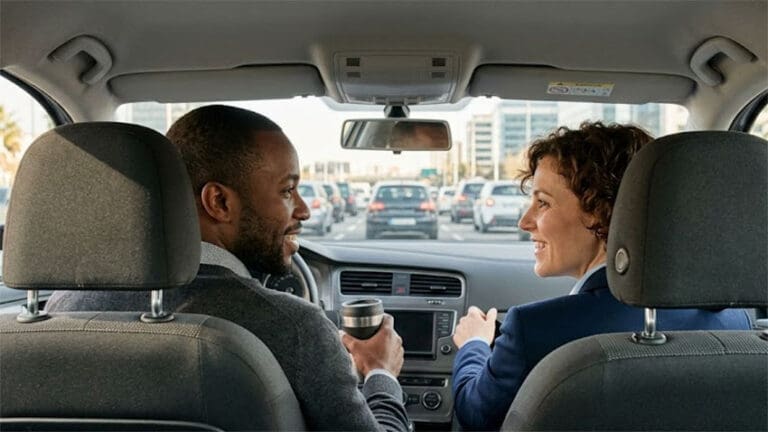
The modern daily commute is facing a critical inflection point. For decades, the image of a successful professional was tied to a solitary drive in a personal vehicle—a symbol of independence and status.
Today, that same image represents an operational bottleneck, an environmental liability, and a primary source of workplace stress. As urban centers become increasingly congested and commercial real estate costs for corporate parking spaces skyrocket, organizations can no longer treat employee transportation as a secondary concern. The infrastructure of yesterday is simply incapable of supporting the workforce of tomorrow.
To bridge the gap between sustainability mandates and operational reality, forward-thinking enterprises are shifting away from passive transportation policies and turning toward Corporate Carpooling as a core mobility strategy. Scope 3 emissions—which encompass indirect emissions throughout a company’s value chain, including employee commuting—frequently represent a significant portion of a business’s total carbon footprint. By converting a disjointed grid of single-occupancy vehicles into a synchronized, efficient network, organizations can actively optimize the daily journey to the office, simultaneously delivering on ambitious Environmental, Social, and Governance (ESG) targets while reducing overhead costs.
1. The multi-layered benefits of shared mobility solutions
When looking closely at the mathematics of the daily commute, the inefficiencies are staggering. Millions of vehicles hit the asphalt every morning carrying only a single passenger: the driver. This systemic underutilization of assets accelerates the wear and tear on urban infrastructure, severely degrades local air quality, and forces companies to dedicate vast swathes of expensive real estate to multi-story concrete parking structures. By introducing shared mobility frameworks, businesses can immediately tap into a wealth of hidden operational advantages that directly impact the bottom line.
From a purely financial perspective, the traditional model of individual commuting creates immense hidden overhead. Companies operating in metropolitan areas face premium lease rates for parking blocks, money that could otherwise be allocated to core research and development or workspace innovation. When employees embrace a culture of shared transportation, the demand for physical parking bays drops dramatically. This spatial reclamation allows corporate facilities managers to downsize their real estate footprint or repurpose concrete parking zones into green communal spaces, collaborative outdoor lounges, or additional office infrastructure.
Beyond the physical asset optimization, the human element of shared mobility is equally compelling. The psychological toll of navigating gridlock traffic alone is well-documented, often leading to elevated cortisol levels and cognitive fatigue before an employee even clocks in. By distributing the driving responsibility among colleagues, professionals can transform dead travel time into an opportunity for relaxation, casual reading, or low-stakes collaboration. Furthermore, shared commutes naturally break down corporate silos, allowing team members from entirely different departments to converse, network, and build interpersonal trust outside the structured pressures of meeting rooms and digital dashboards.
2. Driving change: The Hybo Corporate Carpooling service
To bridge the gap between corporate intent and seamless execution, Hybo has integrated a sophisticated, automated carpooling engine directly into its comprehensive workspace management ecosystem. Organizing a successful, sustained carpooling network across a large enterprise requires aligning an immense number of fluid variables, including varying shift schedules, disparate residential neighborhoods, personal comfort preferences, and sudden changes in daily itineraries. Hybo eliminates the administrative friction that has traditionally plagued shared transit programs by embedding route optimization directly into the daily workflow.
The strength of Hybo’s service lies in its algorithmic simplicity for the end-user. Rather than requiring employees to navigate a secondary, disconnected transportation app, Hybo synchronizes transit coordination with desk and space bookings. When an employee schedules a day to work from the physical headquarters, the platform cross-references their residential zone and shift hours with data from nearby colleagues. The system then automatically proposes optimized pairings, mapping out the most efficient routes to ensure minimal detours and maximum punctuality.
To actively incentivize adoption, Hybo connects carpooling directly to parking asset allocation. Shared vehicles can be automatically granted priority access to prime, front-row corporate parking bays, complete with automated license plate recognition and integrated EV charging scheduling. Simultaneously, the platform acts as a critical telemetry tool for executive leadership. Every shared trip is tracked and converted into verifiable environmental data, calculating the exact metrics of carbon reduction and fuel saved[cite: 3]. These insights are automatically aggregated into visual compliance dashboards, providing corporate sustainability officers with audit-ready, empirical proof of Scope 3 emission reductions to substantiate their annual ESG disclosures.
3. The ecological and cultural return on investment
Implementing a smart, software-driven carpooling architecture yields dividends that ripple far beyond basic fuel savings. On a macro environmental scale, the collective reduction of hundreds of individual vehicles commuting to a single corporate hub creates a measurable decrease in local gridlock and urban greenhouse gas concentration. When an enterprise scales this behavior across thousands of employees globally, the environmental impact transitions from a symbolic gesture to a powerful, systemic force for ecological preservation, aligning perfectly with international net-zero benchmarks.
The Structural Impact: True sustainability is achieved when green practices are woven directly into the operational software of a business. By automating the shared commute, enterprises transform eco-friendly choices from an individual chore into the default, friction-free corporate standard.
Culturally, the shared journey acts as an organic catalyst for employee engagement and well-being. The modern workplace can occasionally feel fragmented, particularly within hybrid frameworks where teams rarely interact face-to-face across different organizational layers. The shared space of a carpool creates a unique social environment where horizontal communication happens naturally. Junior associates gain invaluable mentorship insights from senior managers, cross-departmental alignment improves organically, and the sense of isolation often exacerbated by remote work models is replaced by a tangible, supportive corporate community.