
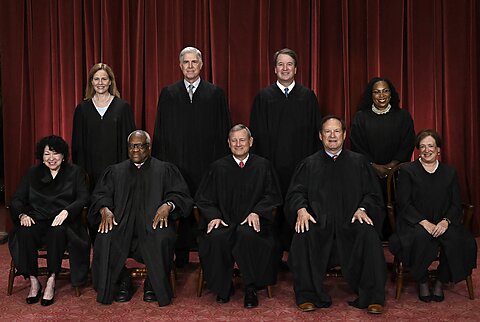
On June 30, the Supreme Court struck down President Trump’s executive order purporting to limit birthright citizenship. That order would have denied citizenship to children born on US soil if their parents were in the United States only temporarily or illegally. But the Court held that the Fourteenth Amendment guarantees citizenship to such children, as it does for nearly all children born on US soil. The Court’s opinion by Chief Justice John Roberts correctly interprets the original meaning of the Fourteenth Amendment and ensures that nearly universal birthright citizenship will continue as the law of the land, just as it has since the English common law.
The Fourteenth Amendment commands, “All persons born or naturalized in the United States, and subject to the jurisdiction thereof, are citizens of the United States and of the State wherein they reside.” The key debate in this case hinged on the meaning of the middle portion of that sentence: “subject to the jurisdiction thereof.” Looking at history, the Court found that this phrase had a clear meaning: jurisdiction is about being subject to a nation’s laws.
“Before the Revolution, the American colonists—like all in the British Empire—were considered subjects of the sovereign.” And this relationship between the King and his subjects came with both responsibilities and benefits. “The King, Blackstone explained, owes those ‘born within the dominions’ a duty of ‘protection.’ … And ‘in return for that protection,’ those ‘born within the dominions’ owe the King a ‘duty’ of ‘allegiance.’” This reciprocal relationship extended to everyone born on soil controlled by the King. “A foreign mother could enter the British Isles, give birth, and leave with her child the very next day, and that child would remain a British subject. Why? Because the child owed an implied allegiance to the sovereign who protected him at his birth.”
Of course, America has no king, but many aspects of English common law were adopted by analogy after independence. “This view crossed the Atlantic with the colonists—and was adopted with little fanfare after the Revolution, as ‘subject[s]’ of the sovereign became ‘citizens’ of the States. And the same logic applied to children born in the states: if they were born subject to the laws of the state, they were also born citizens of the state.”
As Chief Justice Roberts lays out, the logic of this rule also explains its exceptions. Ambassadors and diplomats from another country have long been held to have “diplomatic immunity,” meaning they are not subject to all the laws of the country they temporarily inhabit. So, children born to ambassadors and diplomats were not “subject” to the country of their birth and thus not born citizens. In America, the same logic led states to conclude that those born on Indian tribes were also not automatically citizens of the state because they, too, were not fully subject to state law.
These were the only two recognized exceptions to birthright citizenship until the Supreme Court’s “odious decision of Dred Scott v. Sandford” in 1857, which held that the rule of birthright citizenship “excluded all those descended from slaves.” After the Civil War, the Reconstruction Congress sought to both overrule Dred Scott and prevent any future diminishment of the rule of birthright citizenship. First, in 1866, the Civil Rights Act declared that “all persons born in the United States and not subject to any foreign power, excluding Indians not taxed, are hereby … citizens of the United States.” Then, to avoid all doubt and remove the power of future Congresses to revoke this rule, the Fourteenth Amendment guaranteed that all persons born in the United States and “subject to the jurisdiction thereof” are citizens.
As Chief Justice Roberts sums up, the meaning and purpose of this language is made clear by the history leading up to it. “Any child who was born ‘under the protection of’ the United States—that is, any child for whom no extraterritorial fiction applied—was made a citizen, for he owed a natural ‘allegiance’ (and thus ‘obedience’) to the Nation.” In practice, that means the Fourteenth Amendment guaranteed citizenship to all born in the United States, except those born to diplomats or within Indian tribes. Immigrants, even those here illegally or only for a short time, are subject to U.S. law and thus bound to both its restrictions and its benefits. The default rule of birthright citizenship, therefore, applies to them.
The Court’s decision is exactly right. In Cato’s amicus brief, we argued that “The Fourteenth Amendment was meant to extend its broad protections to ‘all persons,’ with only narrow exceptions rooted in the common law. … ‘All persons’ includes the children of temporary visitors and aliens.” Just as we urged, the Court rejected the government’s cramped view, which is that “jurisdiction” refers only to those subject to “political jurisdiction” who have “lasting ties to create allegiance” to the United States. In the government’s view, this meaning of jurisdiction would exclude the children of parents who are temporarily or illegally in the country. The dissents by Justices Thomas, Alito, and Gorsuch (and a partial concurrence by Justice Kavanaugh) each make some version of this argument (though mostly limited to temporary visitors rather than unauthorized residents).
But as the majority opinion put it, “there is scant evidence for this dramatically revisionist view.” To prove its case, the government would have had to show that “At some point before the ratification of the Fourteenth Amendment, … it became ‘deeply rooted’ in this country that ‘[d]omicile is the key concept that creates allegiance.’” But history does not support such a change in the common law. Instead, right up to the Fourteenth Amendment’s enactment in 1868, legal sources “defined ‘allegiance by birth’ just as the British did—as ‘the tie or duty’ owed by one who is ‘born within the dominions and under the protection of a particular sovereign.’”
The Court’s decision is a reaffirmation of a rule that had been nearly undisputed for over a century, since the Supreme Court’s decision in United States v. Wong Kim Ark (1898). As the Court explained, “What the Court held in Wong Kim Ark was simple: the Citizenship Clause incorporated the common law and granted citizenship to nearly all children born in the United States.” It is the government’s view that would have massively upended American law, injecting tremendous uncertainty into our process for citizenship. But because the Supreme Court ruled on constitutional grounds, it is now certain that no future president or Congress can alter this rule.
Those born on American soil are American citizens, subject to our laws and guaranteed our protection. This rule has helped generations of immigrant families quickly assimilate into equal status as Americans. The rule’s continued vitality and constitutional protection are something to be celebrated.