
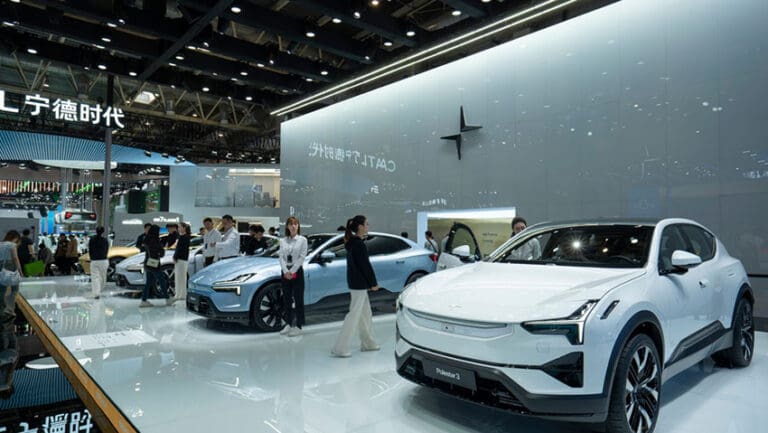
Polestar, the part Chinese-owned electric brand spun out of Volvo, is to abandon the United States after the Commerce Department refused it permission to keep selling new cars, making the company the first casualty of a sweeping American clampdown on Chinese technology in vehicles.
The decision is the opening blow from a rule designed to strip Chinese-written software out of any new car that connects to the internet, a measure Washington frames as shutting the door on the cameras, microphones and GPS systems that it fears could be turned into surveillance tools by a hostile state. For Britain’s small and medium-sized suppliers watching the trade winds, it is a pointed reminder that ownership and code, not just where a car is bolted together, now decide market access.
Polestar, which is controlled by the Chinese motoring giant Zhejiang Geely Holding Group, had applied to carry on selling under a waiver process written into the rule. The government turned it down, the company confirmed on Thursday. The Commerce Department did not immediately comment.
The brand said it would keep selling its remaining American stock and would honour servicing and repairs through its existing network, leaving current owners covered even as the shutters come down on new sales.
Drawn up under the previous administration, the “connected vehicle” rule restricts the import or sale of cars whose hardware and software are tied to China, on national-security grounds. The final rule took effect in March 2025 and has been carried forward rather than unpicked by the current White House.
Carmakers were given until March of this year to certify to the US government that their products carried no code written in China or by a Chinese company, or else to petition for authorisation to keep selling from the 2027 model year onwards. It is a high bar, and one that bites on corporate parentage as much as on the bill of materials.
That distinction explains an awkward split within the Geely empire. Volvo, also majority-owned by the Chinese group, secured authorisation in May to keep trading in the US, after what it described as a case-by-case review and talks with officials over its technology and data security. Polestar, working through the same process, did not clear it.
The rejection is the latest step in a broader American push to wall off Chinese-owned cars. Lawmakers have spent recent weeks floating legislation that would go further still, barring Chinese manufacturers from even building vehicles on US soil.
Polestar had sounded confident it would comply. Chief executive Michael Lohscheller said in a recent interview that the company was “in good dialogue with authorities” about an exemption, adding: “The US is important because obviously it’s a big market.”
Founded as Volvo’s performance and motorsport arm, Polestar became a stand-alone brand in 2017 and was hived off as a separate company in 2021, floating through a special-purpose acquisition vehicle at the height of the electric-car frenzy, when traditional carmakers and start-ups alike scrambled to chase Tesla’s vertiginous share price.
It launched with the limited-edition Polestar 1, a hybrid coupe priced at $156,000, and the Polestar 2, a sporting electric saloon built in China that took early aim at the Tesla Model 3. But a thin line-up left it exposed, particularly in the US, where buyers lean heavily towards SUVs and pick-up trucks. The shares now change hands at $19.22, down 96 per cent from a closing peak of $459.90 in November 2021.
Its Chinese ties had already proved costly. Punitive tariffs imposed by both the Biden and Trump administrations pushed the China-built Polestar 2 out of the American range. Today the brand sells the Polestar 3 SUV, made at Volvo’s plant in South Carolina, and the Polestar 4 SUV, shipped in from South Korea, neither of them built in China.
Polestar said it would now concentrate on shoring up its European business, which already accounts for roughly 80 per cent of global sales. The pivot lands at a moment when the politics of Chinese-built electric cars is fraught on both sides of the Atlantic, with the EU pressing ahead with tariffs on Chinese electric vehicles despite resistance from Germany.
Britain, for its part, is treading a notably different path, courting rather than repelling Chinese capital. The recent Nissan deal to build Chery’s cars in Sunderland underlines how far the UK’s calculation diverges from Washington’s, even as ministers face their own pressure to rethink the 2030 timetable for phasing out petrol cars.
For Lohscheller, the lesson is that the global car market is fragmenting along geographic lines. “The automotive industry is entering a new phase, based on regional dynamics,” he said on Wednesday. For Polestar, that new phase begins with a continent’s worth of ambition and a closed door in the world’s most valuable car market.